
What Is a Combine Harvester?
The combine harvester is a huge, high-tech farming machine that helps farmers quickly and efficiently harvest grains like wheat and corn. Over the years, combines have gone from being simple devices to becoming some of the most advanced machines on the farm.
How Does a Combine Work?
A combine moves down rows of crops using its front part called the reel—a big, six-sided metal piece that spins and scoops up the grain stalks. The design of the reel can change depending on what crop is being harvested. For example, a wheat reel pushes the stalks toward a sharp cutting bar that slices them just below the grain heads, while a corn on the cob reel pulls the ears from the stalks.
After the wheat stalks are grabbed, they are pushed up against a cutter bar that looks a lot like a comb. The “teeth” of this comb catch the stalks, and a knife slices them near the ground. These cut stalks are moved by a spinning metal cylinder, called a stalk auger, onto a moving elevator belt that carries them up into the middle of the combine.
Inside the combine, the stalks reach the threshing cylinder—a large spinning roller with bumps on it. This cylinder spins quickly over a special curved tray with slits (the concave). The beating and spinning action knock the kernels of grain free from the heads of the stalks.
The leftover stalks move onto a series of straw walkers: large, square platforms that shake and move the straw toward the back of the combine. The shaking helps drop the straw so it can be left on the ground or packed into bales. Meanwhile, the small kernels of grain fall through the slits in the concave and land in a tray called the grain pan. The pan and a set of vibrating sieves separate the kernels from pieces of chaff (the lightweight shells and bits around the seeds).
A strong fan blows air over the sieves, which sends the light chaff out the back of the combine. Any grain heads that didn’t get threshed are sent back to the threshing cylinder for another try. The clean kernels fall into a grain auger, which moves them up into a large storage tank on the combine. When the tank is full, an unloading auger helps move the grain out to a waiting truck.

The History of Combines
Back in the 1800s, inventors wanted to help farmers harvest grain faster and easier. Early machines could only do one of two jobs: reaping (cutting the stalks) or threshing (separating grain from chaff).
A Scottish minister named Patrick Bell designed the very first reaper in 1826. Later, an American named Robert McCormick and his son Cyrus improved the reaper, with Cyrus selling the first McCormick Reaper in 1839.
Threshing machines started in the late 1700s and were common in England and Scotland by the 1830s. In America, inventors like Hiram and John Pitts created the “Chicago Pitts” thresher in 1852, and Jerome Increase Case founded his famous company in 1844.
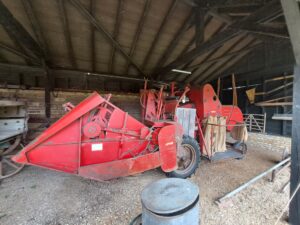
The first machine that could both reap and thresh was patented in 1828, but it wasn’t sold until 1838. These early combines were enormous and needed twenty horses to pull them! Because they were so big and tricky to use, combines didn’t become popular until the early 1900s, after they were improved.
Modern Combines
Today, combines are incredibly complicated. While a regular car has about 6,000 parts, a combine has more than 17,000! This makes them very expensive—a single combine can cost up to £75,000. Today, most of the machines that work their way through Britain’s harvest of grain, oilseeds and pulses are built in Belgium, Germany, Italy and the United States, with a handful making the journey from Croatia, Finland and Poland.