By Steve Crane
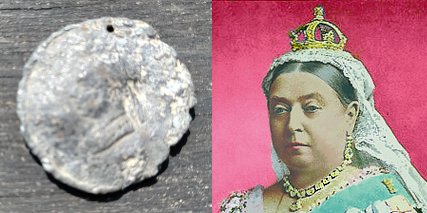
This rather battered and frankly undistinguished item discovered in our Museum store turns out to represent a key historical moment, not only when the British Empire was at its zenith, but also when a pattern was set for commemorating royal anniversaries that persists to the current day.
Our object is a lead disc, approximately 3cm in diameter, with a small hole close to the rim. It’s just possible in the right light to make out a head on one side and some writing on the other.
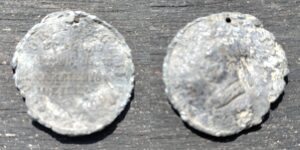
Fortunately we managed to find an image online (courtesy of Cambridgeshire Coins) which shows an identical item in good condition. It’s a medallion issued to commemorate the Golden Jubilee of Queen Victoria in 1887: one side shows the Queen’s head with a very distinctive style of headdress that was crucial in identification of the object, while the other side lists her key dates: birth (1819), coronation (1838), marriage (1840) and golden jubilee (1887).
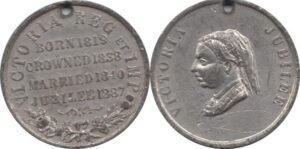
Note that the Queen’s title on the reverse (‘tails’ side) is given as VICTORIA REG ET IMP, an abbreviated form of VICTORIA REGINA ET IMPERATRIX, which is Latin for Victoria Queen and Empress. She had been officially recognised as “Empress of India” (not by its inhabitants, of course) in 1876. This was in part a response to the creation of the German Empire in 1871, with the new Kaiser (= Emperor) now outranking a mere Queen!
Royal Jubilees
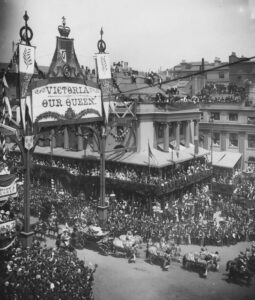
The first royal jubilee medals were issued in 1809 to celebrate 50 years of King George III’s reign (James VI of Scotland, Henry III and Edward III also reached 50 years , but little is known about any contemporary festivities). Public celebrations for George III were relatively muted, but by the time of Queen Victoria’s Golden Jubilee in 1887, everything was on a much grander scale, no doubt reflecting the national mood at the peak of Empire. This was also an opportunity for a reset of the monarchy’s public image: Victoria had come in for a lot of criticism following her withdrawal from public life after Prince Albert’s death in 1861, some 26 years earlier. Senior members of the Royal household were well aware of this and saw the Jubilee as an excellent opportunity to rebuild the links between the Queen and her people. It’s also true to say that the 1887 Jubilee set the pattern for later similar celebrations, most recently Queen Elizabeth II’s Platinum Jubilee in 2022.
Jubilee Souvenirs
Medals in gold, silver and bronze were awarded to those who participated in the official celebrations such as the London parade and the Royal Naval Review. But unofficial souvenirs were also in great demand from the general public, ranging from postcards and other paper ephemera, through the cups, plates and other ceramic items which are perhaps the most common survivors, to medals which imitated the official items to a greater or lesser degree.
Medals and medallions were produced in a range of materials from base metals (lead and cheap alloys) all the way up to gold. There was a huge variety of designs, though most (like ours) listed the key dates for Victoria. Many were commissioned by bodies such as schools and local councils.
Our medal is definitely from the lower end of the scale! Given its condition and the base metal it’s made from, it has very low value in financial terms, but of course it is a fascinating item of social history.