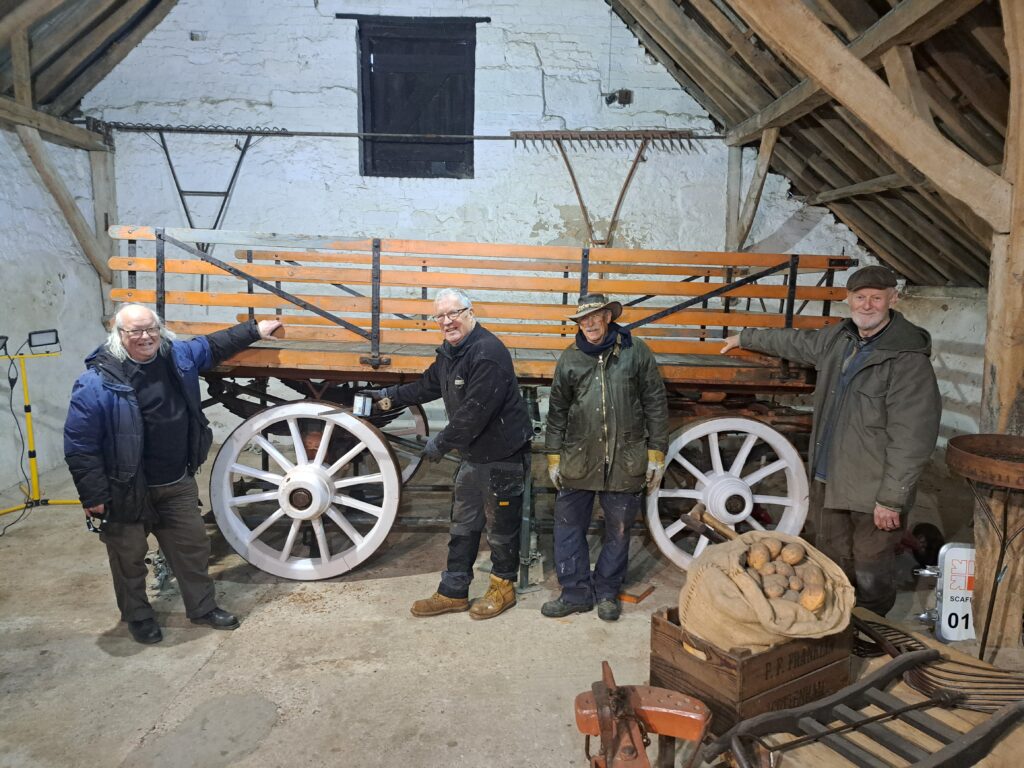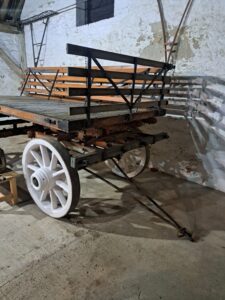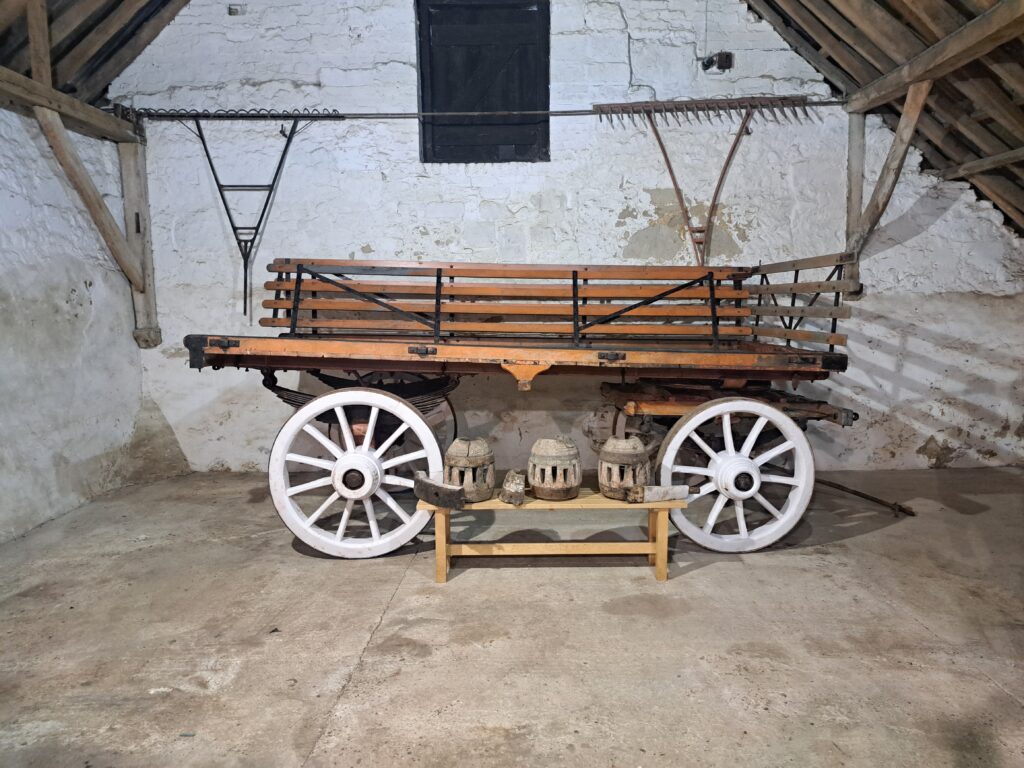
In November 2024, the Farmland Museum began an important conservation project on the Martin Family Potato Wagon — a unique and historically significant vehicle with strong connections to the local area. At the start of the project, the wagon’s wheels were in very poor condition, with one having completely detached from its hub.
History of the wagon
The wagon belonged to the Martin family of Littleport, who once owned the land and buildings on which the Farmland Museum now stands. The family continues to farm in the Cambridgeshire Fens today, including land next to the museum.
What makes this wagon especially unusual is its leaf-bed springs, which are rare on a flatbed wagon. As well as the fact that there are fittings for horse shafts and brackets for a tow bar. These adaptations show how farmers modified traditional equipment to keep pace with changing farming technology.
The Martin family purchased the wagon at the Royal Agricultural Show in Cambridge in 1922, the first show held after the First World War. The event was so large that a temporary railway station had to be built to serve it.
During railway strikes in the 1920s, the wagon was loaded with potatoes and travelled from Cambridgeshire to London, pulled by a Ruston traction engine. A police officer accompanied the driver, and the two-day journey was completed without incident.
Conserving the Wagon
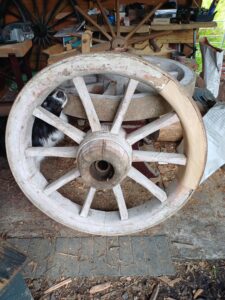
Thanks to a grant from the AIM Pilgrim Trust Remedial Conservation Grant Scheme, the museum was able to employ a wheelwright to repair the damaged wheels. In November 2024, the wheels were removed, and the museum’s volunteer team, led by conservator George Monger, began the conservation process for the rest of the wagon, including its distinctive leaf springs.
The wooden surfaces were treated with a mixture of linseed oil and white spirit to stabilise the wood and revive the original paint. Rust was carefully removed from the metal fittings using wire wool.
Wheelwright Robin Hill restored the wheels using as much original material as possible. One wheel, however, was too badly damaged and had to be completely reconstructed using new timber.
What We Discovered
The conservation work revealed several surprising discoveries. Firstly, the wagon was not originally white. Through the conservation processes of white spirit and linseed oil, layers of red and orange paint were uncovered — bold colours that would have made the wagon highly visible in fields and on roads.
Secondly, stamped markings found on the axles date the wagon to 1915, making it older than previously thought. It also reveals the manufacturers involved in construction and later repairs: James Leach of Leeds, W. Rainforth & Sons in Lincoln and Lones, Vernon & Holden of Smethwick.
Finally, beneath the red and orange paint lay a layer of grey paint commonly used on military vehicles during the First World War. Combined with the style of the wheels — similar to those of known military wagons of the period — this suggests that the wagon may have originally been built for military use before being sold at the Royal Agricultural Show in 1922.
Completion of the project
In January 2026, the restored wheels were returned to the museum and refitted, bringing the conservation project to a successful conclusion and returning the Martin Potato Wagon to a stable condition.
The Farmland Museum would like to thank the AIM Pilgrim Trust Conservation Scheme, George Monger, Robin Hill, Fourways Scaffolding & Hoist Contractors, and our dedicated volunteers for making this project possible.