By Steve Crane
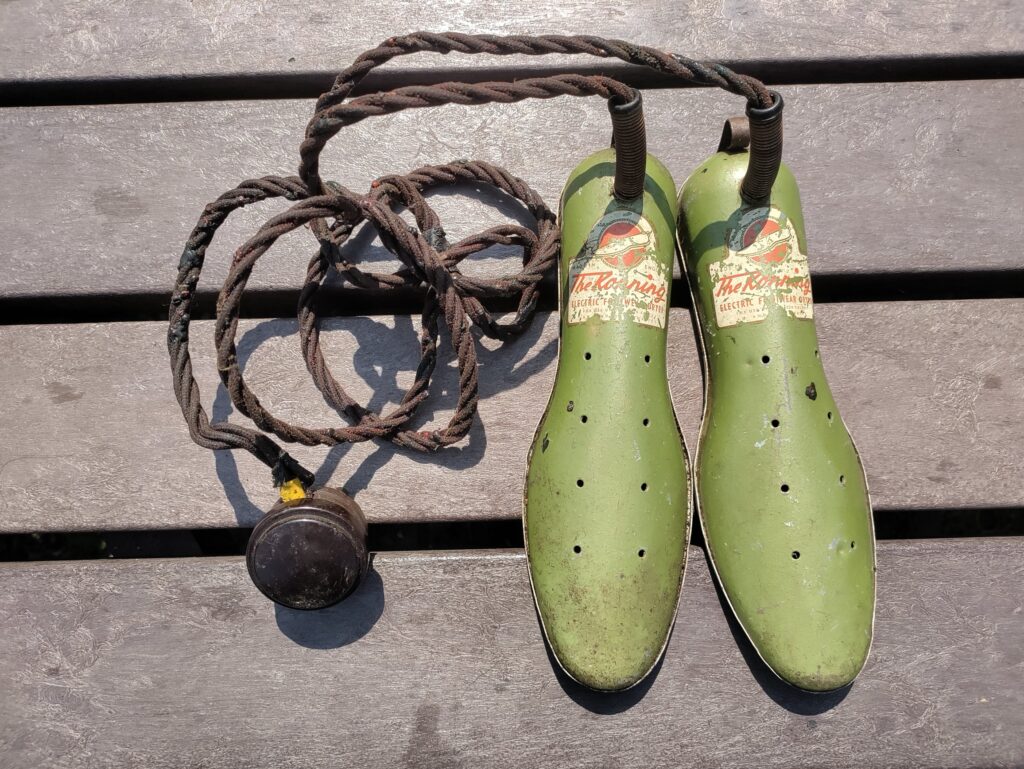
The purpose of these objects is no mystery, thanks to the somewhat battered labels that still survive on them. The principle is straightforward – they are placed inside damp shoes or boots, and plugged into the mains electricity supply, activating internal heating elements. Made of aluminium, the green-painted top surface of each dryer has eight small vents, while the base has four risers, ensuring warm air can circulate freely. The power consumption of each dryer is only 8 watts, so they were unlikely to overheat!
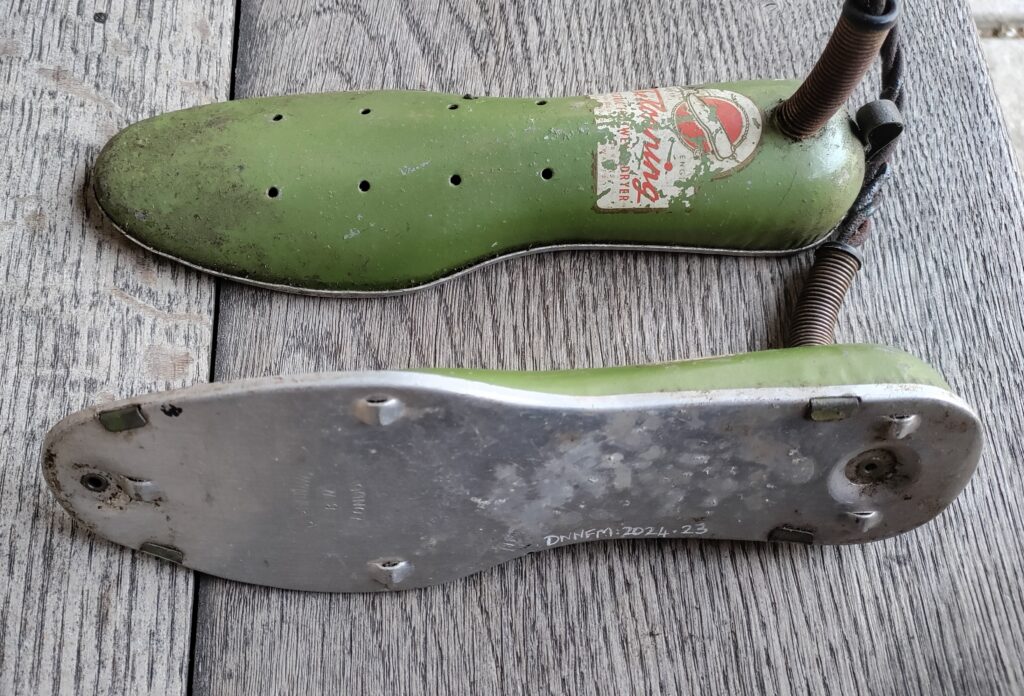 The Science Museum has a similar artefact in its collection, which they date to 1945-55, though I suspect ours are more likely to be from the late 1950s. Our set was made in the UK by R. Ronning of London. Although new electric shoe dryers can still be purchased today, they are not a common household appliance. But at the time these ones were made, very few houses in the UK had central heating: if you had wet shoes or boots, for most people the only way to avoid that horrible cold and damp feeling when you pulled them on the next morning was to stuff them with newspaper, put them in front of the open fire and hope that didn’t damage the leather.
These were also comparatively expensive items. A set for sale on eBay still carries its original pre-decimalisation price label of £2 14s 8d (£2.73), which is the equivalent of over £60 today.
Patents
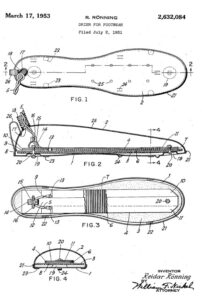 Reidar Rönning was a Norwegian who was awarded a patent for an improved shoe dryer in
his home country in November 1943. However, the basic idea is much older and similar patents were awarded to other inventors in the USA as least as far back as 1925. Rönning’s US Patent No. 2,632,084, awarded in March 1953, is interesting as it shows the internal construction of the dryers, with a metallic heating coil (labelled 6 in the diagram below) insulated by layers of asbestos (3) and mica (7 and 8).
The image below, taken from a box in which these dryers were packaged in the USA, claims that over one million sets had been sold in Europe.

A Note on Electricity Supply
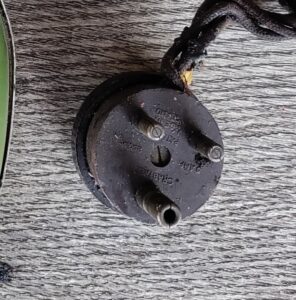
The bakelite mains plug on these dryers is also worthy of comment. British Standard BS546, dating from 1934, defined three sizes of plug and socket, all with three circular pins, for appliances rated up to 2A, 5A or 15A. This coincided with the development of the National Grid and the adoption of a standard voltage across the country. These plugs are still in use today for specialist applications (eg theatre lighting), but for domestic use they were superseded in 1947 by BS1363, which defined the square pin types we use today. Of course the older types remained in use for many years after that: from personal experience many houses still had the circular sockets in the late 1960s.