
In the module ‘Every Object Tells a Story,’ Anglia Ruskin students have learned that objects are not just remnants of the past but active historical sources revealing how people lived and understood their world. This article is part of an online exhibition that showcases the museum’s collections and highlights the importance of object-based learning. We invite you to join us as we uncover the unique stories behind various objects and what they reveal about our past.
Scythes in the Farmland Museum
Aidan Laws
Scythes were a common tool on farms, long before reaping machines such as combine harvesters replaced them during the late 19th and 20th century. The Farmland Museum is home to a few of these ubiquitous tools, and each can tell a very different story.
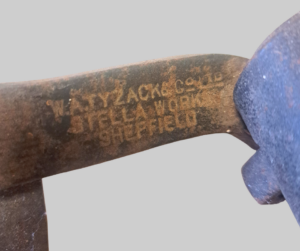
The museum has little information on this scythe, but the quality of the blade, damage and manufacturing markings allow historians to narrow down where this tool was built and used, as well as when this took place. The scythe in question is an example of an English design which was more common in the south of England but did see use elsewhere. Such a design is characterised by the curved ash haft (called a sneath) and the heavy blade that is mounted at a right angle to the sneath.
The blade was manufactured by W. A. Tyzack & Co., a prominent historical agricultural tool manufacturer. The head of the tool was likely made in the early 20th century; this can be deduced from the presence of two holes near the back of the scythe where a grain cradle would be mounted, which would gather the crops as the scythe was swung. This addition narrows down the date as it was primarily used in the late 19th century before being phased out as combine harvesters replaced the scythe. The sneath is far newer and made of imported ash from a company called Western, which implies that this tool was heavily used as the sneath had to be replaced.
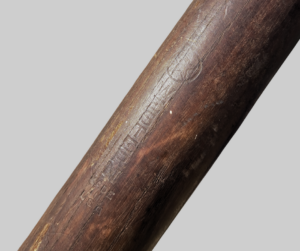
The design of the blade makes it most likely that this tool was used in the south of England, but this can be further narrowed down by another feature of this tool; that of the stone point. Instead, the point is blunted and made of far thicker metal. This made the tool less susceptible to damage and to digging into the ground if used in areas where the terrain was uneven. Furthermore, the blade edge has suffered some damage with notches, which may be due to the blade hitting a rise in the ground. The grain cradle is also of much more use in rugged areas, as most of the grain would be gathered when the scythe was swung, and in rugged terrain, any dropped crops would be harder to gather later. As such, it is most likely this tool was used in an area with moorland and hills like Devon, Somerset or Cornwall.
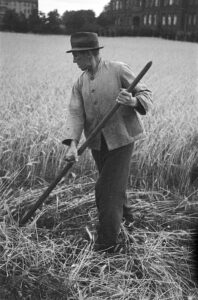
Deutsche Fotothek, CC BY-SA 3.0 DE, via Wikimedia Commons
All of this evidence points to the idea that this blade most likely saw use in the southwest of England and saw considerable use before it came to reside in the Farmland Museum.
While scythes have historically seen the most use as an agricultural tool, by the 20th century, combine harvesters supplanted the hand tool. Nonetheless, scythes are still used in some regions. There is also another setting in which the scythe has risen to prominence, that of gardening and local sustainable farming. The scythe can be used in smaller areas where larger machines would not fit and can be used to deal with tougher foliage. However, even in these new roles, the English design has nearly disappeared in favour of lighter alternatives.
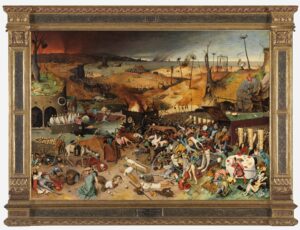
In the 21st century, one of the most common places to find a scythe is at Halloween with the figure Death – often referred to as the Grim Reaper. This association between death and the scythe became popular in the aftermath of the Black Death and can be seen in artwork such as the Triumph of Death by Pieter Bruegel. The concept of the farmer harvesting crops regardless of quality became an analogy for the plague. This is due to how widespread the pandemic was, killing an estimated 50 to 75 million people and touching the lives of everyone who lived in Europe. The name Grim Reaper, which was first used in The Circle of Human Life in 1847, increased this association between Death and the scythe with the term ‘reaper’. With the scythe being supplanted as an agricultural tool, this symbolism is the primary way to see the scythe in our modern age.
References