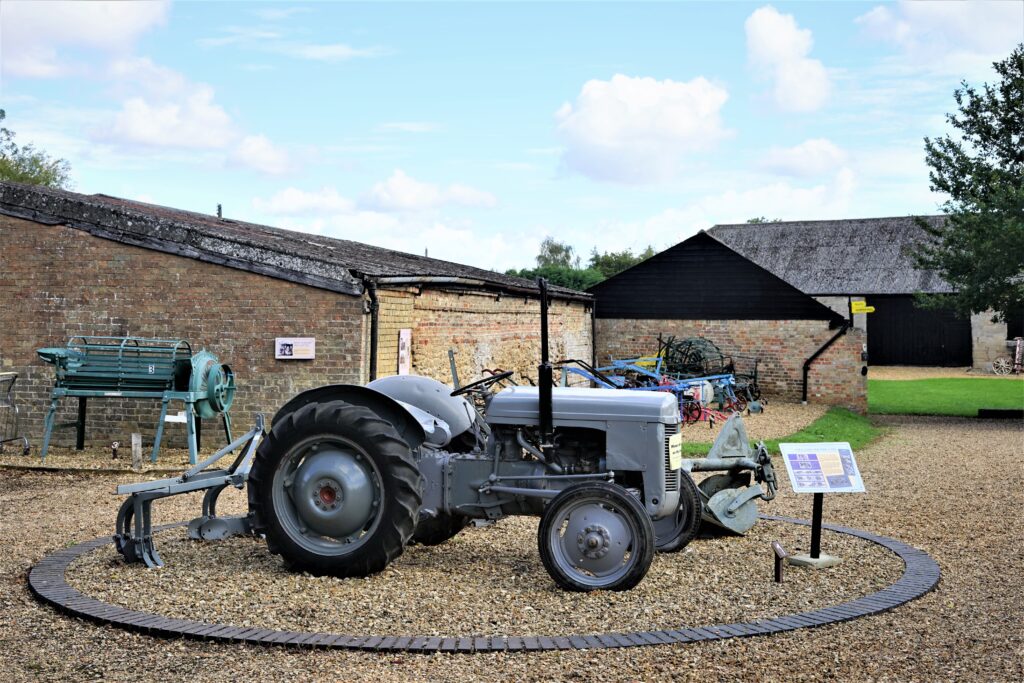
In the module ‘Every Object Tells a Story,’ Anglia Ruskin students have learned that objects are not just remnants of the past but active historical sources revealing how people lived and understood their world. This article is part of an online exhibition that showcases the museum’s collections and highlights the importance of object-based learning. We invite you to join us as we uncover the unique stories behind various objects and what they reveal about our past.
From Postwar Reconstruction to Beloved Status: The ‘Little Grey Fergie’ Tractor
By Henry Thompson-Heap
Throughout human history, there have been objects of all shapes and sizes. Each of these objects function not only as a window into a slice of history, but also as vital clues that help us to understand the modern world. Material objects and artefacts serve as physical records of human creation and progress. They allow us to trace the challenges of time. What follows is an analysis of one such historical object, exploring the context surrounding its creation and the reasons it has secured a place in world history.
Specifically, this piece will focus on the ‘Grey Ferguson Tractor’, also known as the Ferguson TE-20, and even better known as the beloved ’Little Grey Fergie’. Emerging in the post-war 1940s, a period marked by reconstruction and shifts in agricultural practices, the ‘Grey Ferguson Tractor’ became a symbol of efficiency, reliability, and technological and agricultural progress. Its design revolutionised farming by making mechanised agriculture accessible to a wide range of farmers in both developed and developing regions in the postwar world. Its legacy endures, not only as a historical artefact but as a foundational step in the mechanisation that continues to shape modern agriculture today.
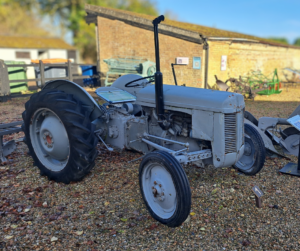
To analyse the impact of the ‘Grey Ferguson Tractor’, the world prior to its creation in 1946 must first be understood. The Second World War, ending in September 1945, left Europe with sweeping socio-economic, geopolitical and agricultural ruin. An estimated 15-20 million European men aged 18-50 were killed, depriving farms of owners and labourers. According to the National British Archives, countless farms and vast farmlands were seized or destroyed. Adding to this catastrophe, food rationing still gripped Europe, strangling the UK until 1954, heightening the urgency for agricultural recuperation to prevent starvation and instability. Europe needed a tool to rebuild its agricultural base, and that help arrived in the form of a little grey tractor from England.
Its creator, Harry George ‘Henry’ Ferguson, born in 1884, began his career as a mechanic working on aircraft before founding his own car and engineering company in 1911. His inventive breakthrough came in 1917 when he adapted a standard Model-T Ford car into the Fordson Tractor. In the early 1920s, he pioneered the hydraulic three-point linkage, later known as the ‘Ferguson System’. Despite delays caused by both the Great Depression and the wars, he successfully produced the Ferguson Model A in 1936 and the Ford-Ferguson in 1939. His crowning achievement, however, was the Ferguson TE-20 tractor in 1946, a machine that sold over half a million units and played a crucial role in Europe’s agricultural reconstruction.
The ‘Grey Ferguson Tractor’ became a backbone of mechanised farming in part due to its hydraulic three-point linkage system, first prototyped in the 1920s, before full integration into this model in 1946. The system comprising Lower Lift Arms, a Top Link, Stabilisers and Draft Control allowed implements to be securely mounted and safely operated. Though simple in mechanical terms, it delivered significant advantages such as better traction by transferring implement weight to the rear wheels, greater versatility with a wide range of tools, improved stability and safety, and consistent working depth through automatic draft control.
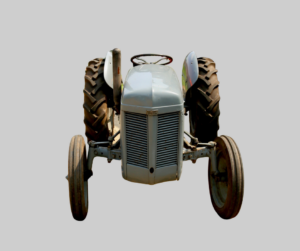
Affordability was also an attractive feature of the Fergie. While typical tractors cost around £1,000 (approximately £53,000 today), the Fergie sold for £325-£600 (around £17,000-£32,000 in today’s money), saving farmers money that they could spend on other essential equipment.
Its durable construction and straightforward technology encouraged easier maintenance and even DIY modifications. The tractor’s manual supported young and inexperienced farmers with labelled diagrams, operating instructions, maintenance schedules and even early service vouchers. Reliable and economical, over half a million TE-20 units were sold worldwide, and it remains in use on some farms more than seventy years after its production ended in 1956. It reshaped both farming practices and tractor design to this day.
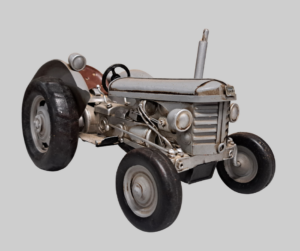
The tractor also became a cultural icon. Nicknamed the ‘Little Grey Fergie’ for its colour, compact size and affectionate link to its inventor, it developed a strong emotional bond with farmers and children alike. Its popularity even inspired toys from Lego and Dublo Dinky Toys, whose long-running models highlighted the tractor’s enduring appeal throughout the generations.
To end this analysis, the ‘Grey Ferguson Tractor’, despite initially appearing to be a mere mid-century piece of mechanised farming equipment, is far more than that. The ‘Grey Ferguson Tractor’ was and still is a significant piece of agricultural history.
Its creation and subsequent popularity redefined what a tractor could achieve and set the benchmark for future agricultural mechanisation across the world. It assisted in the ending of rationing after the Second World War, when Britain and all of Western Europe were facing socio-economic challenges with its food production. It even left enough of an impact on the cultural zeitgeist to have toys and replicas modelled after it. Ultimately, the ‘Grey Ferguson Tractor’ stands not just as a tool of its time, but as a symbol of modern agricultural transformation, as well as post-war resilience and reconstruction.