
In the module ‘Every Object Tells a Story,’ Anglia Ruskin students have learned that objects are not just remnants of the past but active historical sources revealing how people lived and understood their world. This article is part of an online exhibition that showcases the museum’s collections and highlights the importance of object-based learning. We invite you to join us as we uncover the unique stories behind various objects and what they reveal about our past.
Make-up and Beauty in the Mid-Twentieth Century
Aleesha Alexander
This vintage vanity case was made between the 1940s and 1950s and was used by a woman. It contains two glass jars and two glass bottles, with a mirror and a small semi-circle compartment to store small items. There are also two Revlon lipsticks in there, but these lipsticks were not part of the original case. It was manufactured by the company George Marris & Co, called ‘Sirram’ (which is ‘Marris’ spelt backwards). ‘Sirram’ was famous for producing and selling picnic sets and camping equipment. The company operated until the early 1960s but went under soon after. The case is now seen as a collectable.
The vintage vanity case is powder-coated and pink in colour. There isn’t much wear and tear on the vanity case, suggesting it was well-looked after. This vanity case was prominent among women who travelled often, and it was compact and had a growing number of cosmetics and toiletries. The case was also a symbol of status, elegance and luxury among women during the period. They were able to carry and apply makeup in public due to the case, which served as a symbol of their independence and became socially acceptable at the time.
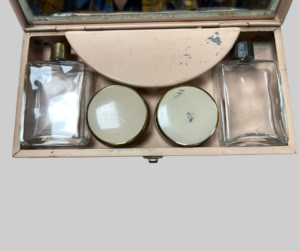
Social class, gender roles and the evolution of personal freedom can be seen in the vanity case. The ‘Sirram’ vanity cases were most famous during the post-WWII era to the 1960s, where glamour was making a comeback after wartime. The cases tell us that their owners were fashionable women who valued practicality, organisation and travel. ‘Sirram’ cases were affordable compared to the famous brands at that time, such as ‘Cartier’, ‘Tiffany & Co’ and ‘Van Cleef & Arpels’, some of whom sold vanity cases encrusted with pearls, tortoise shell and jade.
‘Sirram’ was affordable to every woman from every class, especially the middle-class woman who recently started wearing makeup in public. It also represented the ‘New Woman’ who was no longer confined to the home but was now active in social and professional worlds.
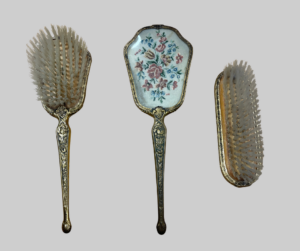
This vintage brush set was most likely made between the 1940s and 1950s by the company Regent of London. The set included a hand mirror, a hairbrush and a smaller clothes brush, all featuring delicate floral needlepoint (petit point) embroidery under a protective layer, surrounded by ornate gold-tone metal frames with filigree detailing. The manufacturer is Regent of London because they were known for their 24k gold coating on their brush sets, while the bristles are either natural or nylon. It has embroidered cloth behind it, which is removable for cleaning.
The Victorian age inspired the brush set design and embroidery. These sets were popular wedding gifts for new brides or for babies, marking a transition into a new social role where grooming and appearance were important. While modern brushes are gender-neutral, in the 18th century, “dressing cases” with high-quality shaving brushes and mirror sets had become primarily feminine “vanity sets” as men’s fashion became more utilitarian.
The brushes were usually part of a larger, organised dressing table set including a hand mirror, comb, and clothes brush and rarely powder bowls. These hairbrush sets are famous for their durability, as they last a long time. The owner of the vintage brush set is unknown, but the object can be read to reveal interesting details of their life.